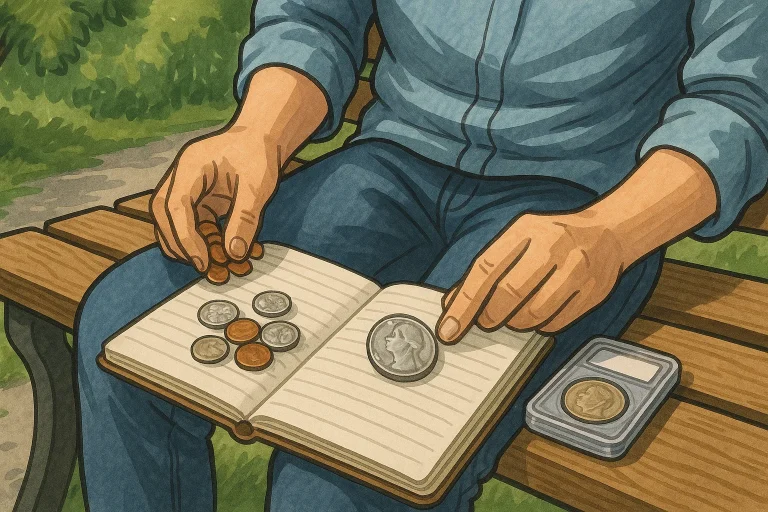
Commemorative coins of the United States of America are special coins made by the US Mint, marking important historical events, important people, important places, or important anniversaries.
But of course, each collection has its own nuances, and it’s difficult for a beginner to keep everything in mind, and you can’t do without the coin scanner app.

The main purpose of issue is:
Often, part of the money raised from the sale of commemorative coins to collectors goes to finance the institutions or projects depicted on the coin, helping to pay for things like the renovation of national parks or the maintenance of museums.
Commemorative coin programs, especially quarter-dollar ones, are a good tool for familiarizing U.S. citizens and others with the country’s history and geography by showing different corners of the country.
Commemorative coins are split into two main groups:
- Circulating Commemorative Coins: These are put into the general money circulation and used for daily payments, like the quarter-dollar coins seen in stores.
- Non-Circulating Commemorative Coins: These are only sold to people who collect coins, costing more than their face value.
The 50 State Quarters Program (1999–2008)
The program started in 1999, having the clear goal of doing several important things:
- Making people more interested in numismatics, which is the hobby of collecting coins, among many ordinary people.
- Giving every state the chance to present its own identity on a quarter-dollar coin, choosing its own important symbols.
- Slowly replacing the older quarter-dollar coins, these older coins have a single, unchanged design on the reverse side for many years.
The program went on for ten full years, starting in 1999 and ending in 2008. The US Mint made exactly five new coin designs every year, dedicating each design to five different states.
The order of release wasn’t random or accidental: the coins came out in the same order that the states ratified the US Constitution.
- The year 1999 saw the release of coins for Delaware, Pennsylvania, New Jersey, Georgia, and Connecticut.
- The year 2008 saw the release of coins for Oklahoma, New Mexico, Arizona, Alaska, and Hawaii.
In the year 2009, after the main program finished, the Mint released six more quarter-dollar coins, these coins being dedicated to the US territories, which are not full states, including Puerto Rico, the US Virgin Islands, Guam, American Samoa, and the Northern Mariana Islands.
Collecting: The whole program was a very big success, attracting many people. Millions of regular people began collecting the coins, taking them directly from their wallets and purses.
This situation caused a short time of too few quarter-dollar coins in general circulation, as people were removing them to complete their personal collections.
The coins were made at two main Mints: the one in Philadelphia and the one in Denver.
Collectors worked hard to gather full sets of 50 P coins and 50 D coins, creating a major collecting boom.
The America the Beautiful Quarters Program (2010–2021)
This program was agreed upon in 2008 and began in 2010, right after the 50 States Program finished its run.
Instead of focusing on the states themselves, the theme of this new program became national parks and other very important national and historical sites, selecting one special place from each state, the federal District of Columbia, and the five US territories.
As part of this program, a separate series of investment silver coins was also made, each one weighing 5 ounces, a very large size for a coin. These specific coins:
- Had the exact same reverse design as the smaller circulating quarter-dollar coins, showing the same park or site.
- Were made of silver that was 99.9% pure, making them very valuable metal pieces.
- Had a face value of 25 cents, but their actual market price was much higher because of their large weight and the material they contained.
- They were mainly created for investors and serious collectors, but they legally held the status of money that could be used for payment.
Modern Bullion Coins of the USA
Bullion coins are coins released mainly as a safe way to invest money in precious metals like gold, silver, and platinum.
They have a small face coin value, like $1 or $50, but their real value is set by the current market price of the metal from which the coin is made — their price changes daily.
The American Silver Eagle
The American Silver Eagle coin was first made in 1986, quickly becoming one of the most famous silver investment coins sold all over the world.
The main function is to be the official silver coin for investors, the coin being guaranteed by the United States government for its purity and weight.
- Metal: 99.9% pure silver
- Weight: 31.103 grams
- Face Value: 1 US Dollar
The American Gold Eagle
The American Gold Eagle coin was also first made in 1986, standing as the main gold investment coin of the United States, popular with banks and investors.
It is the official gold coin meant for all investors, providing a safe store of wealth.
The coin is made of 91.67% gold, with the remaining part being copper and silver. This mix is used to make the coin harder and more durable (22 karats).

Collecting Commemorative and Bullion Coins
Collecting every coin from the 50 States series or all 56 sites from the America the Beautiful series, aiming for complete sets.
- Coins that have been in circulation but still look almost perfect, having very little wear.
- Very special coins made for serious collectors, using polished metal blanks and matte images, resulting in a mirror-like surface and a dull, detailed image. The Mint sells these coins for the highest price, being very attractive.
- Coins that were never used for buying things, made using standard technology, but stored safely since production.
Professional companies, like PCGS and NGC, or the best coin identifier app can assess the coins using a 70-point scale and place them inside special plastic holders, showing the exact score. This grading process is very important for all investment and rare collector coins, helping to set a clear value.
Impact on the Economy and Culture
The making of investment coins, like the Silver and Gold Eagle, creates a constant demand for precious metals, this demand being guaranteed by the government, which helps to influence the world market price.
The quarter-dollar coin programs provide citizens and children with easy-to-see examples of US history and US geography, making learning simple and fun, and teaching about important parts of the nation.
Therefore, the commemorative coin programs in the US, ranging from the circulating ones to the investment ones, aren’t just simple parts of the money system but are also important tools for cultural teaching, for the hobby of collecting, and for putting money safely into precious metals.